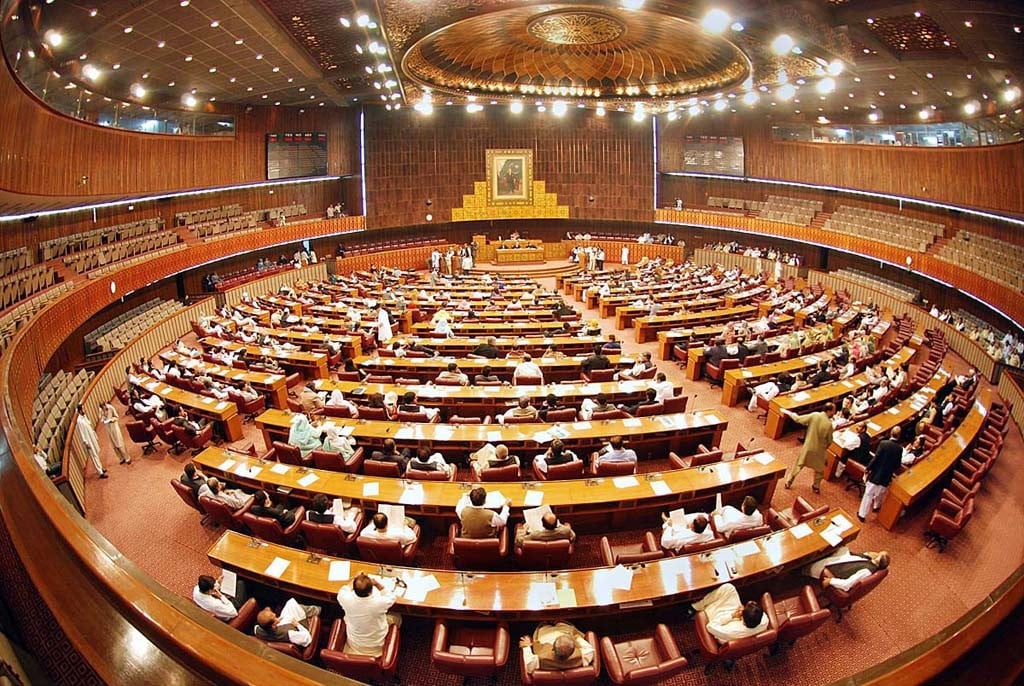

ISLAMABAD: The first National Assembly session of 2025 witnessed low attendance, with only 36 members present at all sittings, while 35 lawmakers did not attend a single session, according to a report released by the Free and Fair Election Network (FAFEN) on Wednesday.
The National Assembly conducted its 12th session from January 13 to January 23, 2025, holding nine sittings to address various agenda items, including the contentious Prevention of Electronic Crimes Amendment Bill.
FAFEN’s report highlighted that the highest attendance was recorded on January 23, with 241 members—68% of the house—present. In contrast, the lowest attendance occurred during the fifth sitting, with only 117 MNAs, or 37% of the total house, in attendance.
The report noted that 96 MNAs (35%) formally applied for leave of absence, whereas 181 lawmakers (65%) skipped the proceedings without prior approval.
Among cabinet members, the housing and works minister was the only one to attend all sessions, alongside the leader of the opposition. The prime minister participated in just two sittings.
According to the report, 36 lawmakers (11%) were present at all sittings, while 35 (11%) were absent throughout the session. Lawmakers from Islamabad Capital Territory (ICT) exhibited better attendance than those from other regions. Overall, 277 MNAs (82%) missed at least one sitting.
The report also highlighted a gender disparity in attendance patterns, with female lawmakers consistently recording higher attendance than their male counterparts. However, only five female MNAs—three on reserved seats and two on general seats—attended all sittings.
Lawmakers from the Pakistan Muslim League-Nawaz (PML-N), Pakistan Peoples Party Parliamentarians (PPPP), Sunni Ittehad Council (SIC), and Balochistan Awami Party (BAP) attended over half of the sittings. The sole BNP lawmaker was absent throughout the session.
Among parties with a single representative, members from the National Party (NP), Pakhtunkhwa Milli Awami Party (PkMAP), and Pakistan Muslim League-Zia (PML-Z) attended more than half of the sittings, while the Majlis-e-Wahdat-ul-Muslimeen Pakistan (MWMP) lawmaker attended all sessions.
FAFEN’s report pointed out that the absence of ministers weakened legislative oversight. The current cabinet consists of the prime minister and 18 ministers—12 from the National Assembly and six from the Senate. Additionally, six MNAs hold minister of state positions, and 30 serve as parliamentary secretaries for various ministries.
The report clarified that Senate-based cabinet members are not typically required to attend National Assembly sessions unless their ministry is under discussion. During Question Hour, 20 ministers were expected to be present, but only six attended all relevant sessions.
Regarding parliamentary leaders, the SIC and MWMP leaders attended all nine sittings, while the PML-N parliamentary leader participated in six. The parliamentary leaders of the PPPP, JUI, and BNP did not attend any session, the report revealed.